Ein neues Mashup aus lokalen Fragen und Insidertipps zu den verschiedenen Städten Deutschlands und einer google Map ermöglicht nun das geographische Browsing durch diese Wissensdaten.
Posts mit dem Label Mash-ups werden angezeigt. Alle Posts anzeigen
Posts mit dem Label Mash-ups werden angezeigt. Alle Posts anzeigen
Montag, September 15, 2008


Dienstag, November 14, 2006
must read: the low-down on mash-ups
 This is a brand new article about mash-ups and it summarizes the importance of open webservices and affiliate programs. My predictions is that affiliate programs from companies like eBay or Amazon will soon be valid financing options not only for internet mashups, but also for IPTV channels and wireless tools. Hey and why shouldn´t modern coffee places, bars or internet cafés run affiliate advertisements in their local storefronts with smart short-codes next to it that bring you directly to a WAP offering, e.g.!? See also my next post about the gap between the offline and wireless world that will soon be closed...
But first read this great article: http://www.ecommerce-guide.com/news/trends/article.php/3643721
Montag, November 06, 2006
Lesetipp zu Mashups
 PHP Magazin, demnächst am Kiosk: http://phpmagazin.de/itr/ausgaben/psecom,id,330,nodeid,60.html
google und eBay - eine prima Kombination :-)
Donnerstag, September 07, 2006
We have seen nothing yet! mash-up developers out there: time for rock 'n' roll!
 Today I held a speach at the Media in Transition conference in Munich (http://www.mediaintransition.com/indexe.html) and discussed new Web 2.0 ideas in an interesting panel discussion with Simon Willison from Yahoo!, Ibrahim Evasan from Sevenload and Tom Dyson from Torchbox. In order to also open up the discussion here on my blog, let me share some of the points I tried to make during my 25-minute presentation...
Hopefully some food for thought and also new mashup ideas:
2. eBay´s developers program as a motor for Web 2.0 innovations:
- eBay has billions of product data available, even including some demographic data, shipping data, product features, pictures and of courses prices.
- data and eBay functionality are available via free webservices APIs and the market data program (http://developer.ebay.com)
- The eBay webservices platform makes integration for 3rd-parties easy by leveraging technology standards (XML, SOAP, REST, https...) plus numerous SDKs
- Numerous companies already use the eBay APIs to mash the data into their applications, e.g. ERP companies, logistic companies, tool developers, hotel chains...
- eBay functionality is migrating into more and more portals such as freemail sites, price comparison sites, wireless apps, IPTV tools and much more
2. eBay´s affiliate programs are a motor for web 2.0 innovations
- Especially new web 2.0 start-ups in the socializing, community, content or networking can make extra money off these programs by integrating relevant eBay items as advertisements into their sites and possibly even targeting these precisely based on their user profiles
- eBay pays you money not only for clicks and bids, but also for new user registrations and even pays you a rev share in the US
- Learn more at http://affiliate.ebay.com or http://partnerprogramm.ebay.de
- tools like the editor kit or the eBay relevance ad let you target the ads in an optimized way
3. Examples and ideas for Web 2.0 mashups around eBay:
- Google Maps or planet browser are currently the dominating mashup trend around local eBay searches and data. Examples include www.2realestateauctions.com, www.markovic.com, www.dudewhereismycar.com and some more
- Another hot topic are plug-ins such as the eBay watcher as part of the google desktop 2.0. I expect many more AJAX dashboards with eBay functionality in the near future
- Mashup idea: www.billmonk.com (facebook) to be mashed as a long-term financing option for students. Imagine your uncle borrowed you 300 bucks to buy a flat screen and you pay him back after a couple of years and remind him: Look this was the eBay item I bought - remember?
- Mashup idea: www.dabbledb.com in order to organize your eBay sales as a professional seller and give access to some suppliers e.g. in order to view relevant statistics or spread-sheets... many more stuff can be done with this cool database / app
- Mashup idea: www.worldofwarcraft.com or www.xuqa.com to be mashed with the gold that is being sold on eBay directly within the game or any other stuff that fits into the story. Or you could even mash it up with google maps and myspace.com in order to find out who and where the people sit in the real world that you are dealing with.
- Mashup idea: Now this mashup is really cool. You gotta try it out: www.slide.com Enter your favorite seller and it will give you a cool slide show about the item this seller is selling. Nothing more needs to be said...rocks - in my opinion...
- Mashup idea: Mash product prices from various platforms into a cool price comparison or analysis site - www.mpire.com is really worth trying out. Checkout the mashing around http://del.ico.us or the post it to Web - option for items. Mashup at its best. www.frucall.com is also an interesting option, still waiting for an eBay API connection
- Mashup idea: collectors corners like www.squirl.info - great to be mashed with the matching eBay items
- Mashup idea: Paypal - Skype - eBay :-) who would have guessed it? But seriously communication (voip, IM, peer to peer, WLAN) and payment offer great opportunities to be mashed...
4. Summary of the panel discussion after my speach:
- Will we have a bandwidth problem with video taking over? Some believe so, but new technologies and ever increasing computing power and bandwidth will overcome the bottlenecks in my opinion.
- What will dominate broadcasting, streaming, ownership, downloads? It all will happen. A daily television programm will be something of the past in 5 years - that`s all I had to say
- Security: A big risk for Web 2.0, since users might get too transparent and not all developer are good you know. It really depends who wins the race. Today the young myspace kids do not worry about all the data they create about themselves, but they will grow older and you watch... I can already hear the human rights activists screaming... and read below in some of my other posts: I am scared already, thinking about all the data I left registering on so many websites out there...
- I also made a comment about the internet and a question from the audience, whether this is a new bubble or not: First of all YES, the word Web 2.0 is too hyped up, but the magic word really is: APIs!!! These create tons of new business opportunities. But in the end... hey, the internet is only 11 years old and WE HAVE SEEN NOTHING YET!
5. Closing comment:
I read in an IT newspaper the other day that a professor predicted that ERP software companies are going to have a hard time competing against Web 2.0 business apps in 10 years from now... hmm - something to think about.
Freitag, Dezember 09, 2005
Ideen zu Web 2.0 und Mash-ups
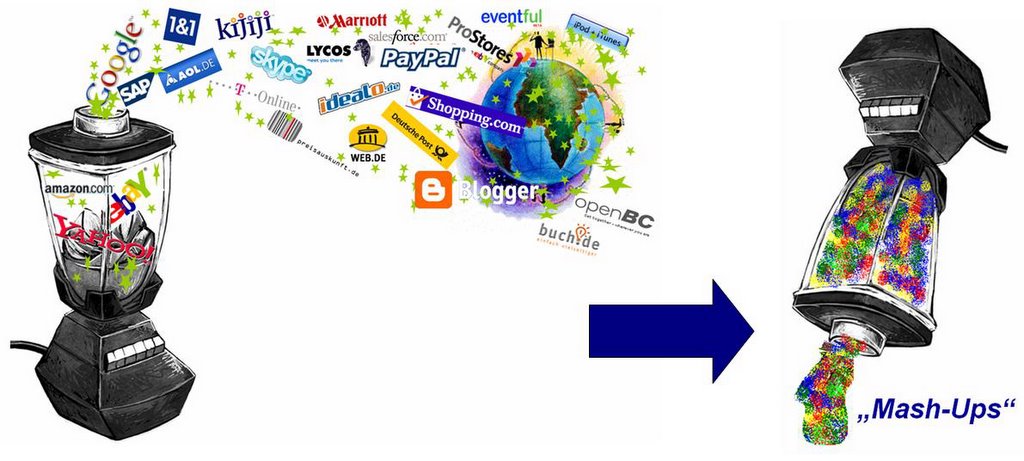
Vor kurzem habe ich auf einer Pressekonferenz von Sun Microsystems über Web2.0 - Das Internet im Mixer gesprochen. Hier einige Auszüge mit der Bitte um Eure Meinungen und Kommentare: 
A - Web 2.0 ist ein Begriff für die Weiterentwicklung des Internet:
Windows:
A - Web 2.0 ist ein Begriff für die Weiterentwicklung des Internet:
- Wandlung der Internetangebote von isolierten Inhalten und Funktionalitäten hin zu Computing-Plattforme
- Wiederverwendung von organisierten und dezentral verwalteten Inhalten
- ein Mix aus Daten und Funktionalitäten => Mash-Ups
- Daten sind der Schlüssel zum Erfolg
- Offene Web-APIs, Web-Standards, Online Web-Services und Web-Feeds
- Raum für neuartige Services mit Netzwerkeffekten
- Web 2.0 mehr als ein Name für das „neue Betriebssystem Internet“
- Service-Ansatz und keine proprietäre Software
- Kontrolle und Bereitstellung von Daten mit Netzwerkeffekten und einfacher Weiterverarbeitung (z.B. Mash-Ups)
- Offenheit gegenüber Nutzern und Entwicklern
- Generierung von Mehrwert durch Nutzerbeiträge
- Kosten steigen unterproportional zur Nutzeranzahl
- Einfaches und individuell gestaltbares Frontend
- Kostenlose Schnittstellen (APIs)
- Unabhängigkeit von Plattformen und Endgeräten
- Meist basierend auf SOAP-, REST- und AJAX-Technologie
- Flickr.com - jeder kann Fotos einstellen und mit Tags versehen und suchen
- Wikipedia.com – Enzyklopädie bei der jeder Nutzer Einträge editieren kann
- eBay.com – Jeder kann verkaufen und kaufen, kostenlose APIs (http://developer.ebay.com)
- Google.com – Jeder kann Websites suchen und bewerben, offene APIs
- Spamfilter-Produkte bei den jeder die Erfahrung anderer nutzt
- Opensource-Projekte wie bei sourceforge.net
- OpenBC.com – Networking über Crossverlinkung und Kontaktdaten
- Eventful.com – Ein Kalender von jedem für jeden
- Greasemonkey als Firefox-Extension zur individuellen Darstellung
- Kijiji.com – Anzeigen von jedermann
- ipod/itunes und podcasting (Audio-Dateien via RSS Feeds)
- Tivo.com – TV-Recordings und mehr
- www.Trachtenberg.com powered by eBay Motors & Google Maps
- www.Housingmaps.com powered by Craigslist & Google Maps
- Blogger.com – Weblogs und Blogs als neue Kommunikationsform
- Das inkrementelle Web: Updates zu Informationen und Veränderungen von Websites und Content über RSS-Feeds
- Planeten-Browser: World Wind und Google Earth
- Neue Messaging-Formate: VoIP, Atoms, RSS, Mail, Blogs, Skype
- Kostenlose Music- und Lausch-Downloads: podcast, mp3
- Opensource z.B. auch bei den Gelben Seiten
- Microsofts RSS Erweiterung SSE (Simple Sharing Extension) zum bilateralen Datenaustausch
- Webservices auf der Microsoft Media Center Edition
- Gemischte Produktkataloge und Datenbanken (API-Content-Pulling)
- Übergreifende Researchmöglichkeiten
- Neue Mobilfunkapplikationen für Standard-Web-Anwendungen
- Verkehrsnachrichten in Echtzeit mittels eingebauter KFZ-Sender
- Neue Kalender und Mailformate
- Erweiterte Enterprise Web-Applications (CRM, ERP)
Windows:
- Windows ist eine Plattform
- Windows ist eine Software
- Windows hat andere Applikationen „besiegt“ (Netscape, Lotus 1-2-3, WordPerfect)
- Lange Release-Zyklen
- Windows war DIE Plattform für die PC-Ära
- Windows arbeitete meist mit proprietären Formaten und Schnittstellen
- Eine Firma entscheidet
Web 2.0:
- Web 2.0 ist eine Plattform
- Web 2.0 ist eine Infoware
- Web 2.0 ist offen für alle Arten von Applikationen
- Stündliche Updates möglich
- Web 2.0 wird DIE Plattform der P2P-/Wireless-Generation und des Distributed-Computing
- Web 2.0 basiert auf offenen Software-APIs und Webservices
- Die Nutzer entscheiden
Abonnieren
Posts (Atom)